Nepal Police is the primary law enforcement agency in Nepal, responsible for maintaining peace, security, and law and order throughout the country. The Nepal Police operates under the Ministry of Home Affairs and plays a crucial role in crime prevention, investigation, and disaster response.
Today, Nepal Police is a modernized force equipped with advanced technology and trained personnel to ensure effective law enforcement.
Structure and Organization of Nepal Police
Nepal Police operates under a hierarchical structure, with various departments and units handling different aspects of law enforcement:
Headquarters: Located in Naxal, Kathmandu, the headquarters oversees all police operations in Nepal.
Metropolitan Police: Responsible for law enforcement in urban areas like Kathmandu, Pokhara, and Lalitpur.
District Police Offices: Each district has a police office responsible for maintaining law and order at the local level.
Specialized Units: These include the Crime Investigation Department (CID), Traffic Police, Armed Police Force, and Cyber Crime Unit.
Border Security Forces: Nepal Police plays a significant role in maintaining security along Nepal’s borders with India and China.
Functions and Responsibilities of Nepal Police
The Nepal Police is responsible for various tasks, including:
Maintaining public order and preventing crime
Investigating criminal cases and apprehending offenders
Traffic management and road safety enforcement
Disaster response and rescue operations
Counter-terrorism and intelligence gathering
Providing security during elections and public events
Nepal Police Recruitment Process
Becoming a Nepal Police officer requires fulfilling specific eligibility criteria and going through a competitive selection process. The recruitment process includes:
Eligibility Criteria:
Must be a Nepali citizen
Minimum age: 18 years (varies by rank)
Educational qualification: SEE/SLC or higher depending on the post
Must meet physical fitness standards
Selection Process:
Written Examination: Covers general knowledge, English, Nepali, and mathematics.
Physical Fitness Test: Includes running, push-ups, and other endurance tests.
Medical Examination: Ensures candidates are in good health.
Interview: Final assessment before selection.
Ranks in Nepal Police
Nepal Police follows a hierarchical ranking system, including:
Inspector General of Police (IGP)
Additional Inspector General (AIG)
Deputy Inspector General (DIG)
Superintendent of Police (SP)
Deputy Superintendent of Police (DSP)
Inspector
Sub-Inspector
Assistant Sub-Inspector
Head Constable
Constable
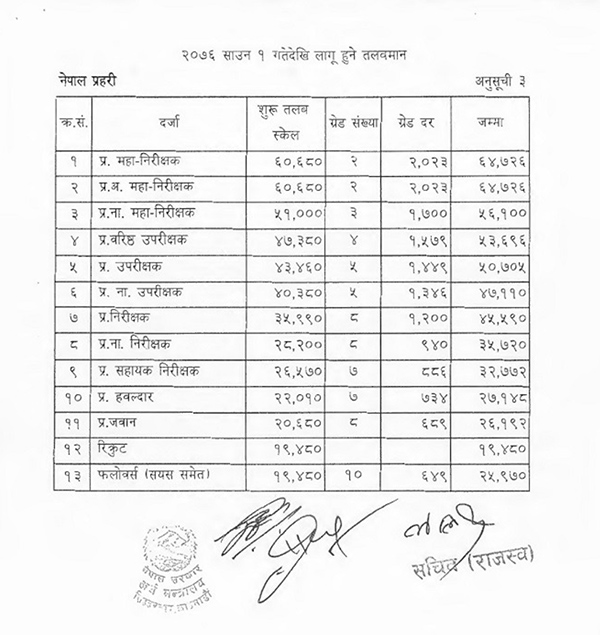
Salary Of Different Level In Nepal Police
S.N.
Rank
Salary
1
Inspector General of Police (IGP)
64,726
2
Additional Inspector General of Police (AIGP)
64,726
3
Deputy Inspector General of Police (DIGP)
56,100
4
Senior Superintendent of Police (SSP)
53,696
5
Superintendent of Police (SP)
50,705
6
Deputy Superintendent of Police (DSP)
47,110
7
Police Inspector
45,590
8
Sub Inspector of Police(SIP)
35,720
9
Assistant Sub Inspector of Police
32,772
10
Police Head Constable
27,148
11
Police Constable
26,192
12
Recruit
19,480
12
Followers
25,970
Challenges Faced by Nepal Police
Despite its crucial role, Nepal Police faces several challenges, including:
Limited resources and outdated equipment
Increasing cybercrime and digital security threats
Political interference in law enforcement
Public trust and accountability issues
Managing law and order during protests and demonstrations
Conclusion
Nepal Police is a vital institution in ensuring peace and security in Nepal. Despite various challenges, the force is continuously improving to serve the nation better. If you’re interested in joining Nepal Police, ensure you meet the eligibility criteria and prepare for the recruitment process.
For the latest updates on Nepal Police recruitment and for preparation in different level , stay connected with Loksewa Tayari App and official website of Loksewa.