Health Assistant (HA) Salary in Nepal Government 2082 — Complete Guide

Last updated: Chaitra 2082 BS (March 2026) — Based on the latest Nepal Government salary scale
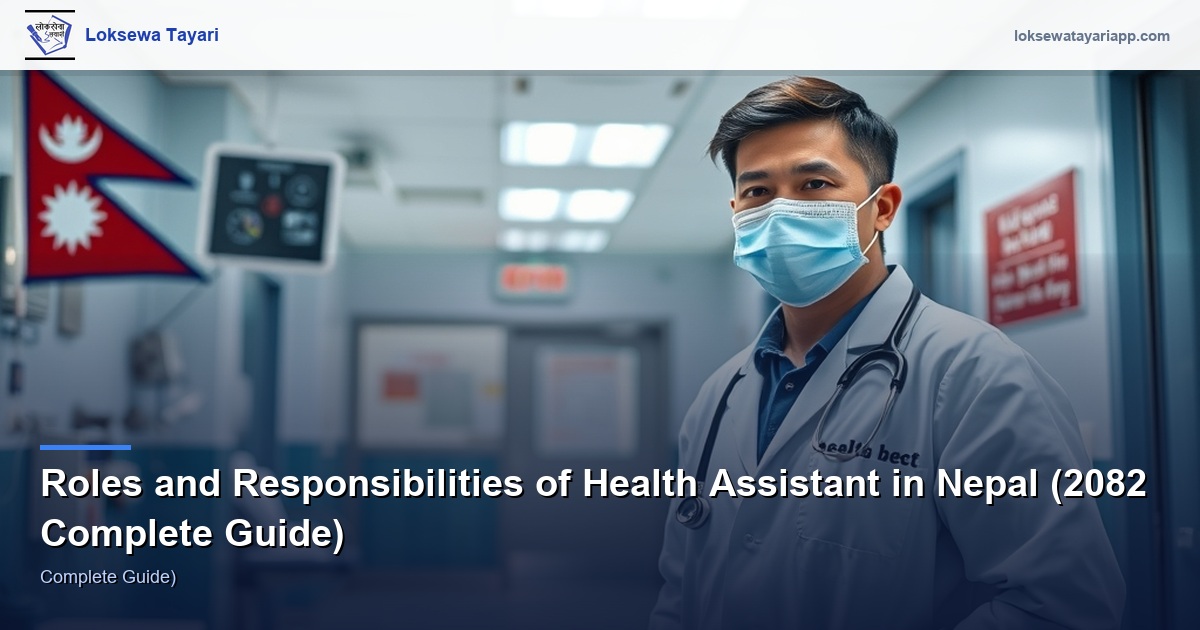
If you ask anyone living in a rural village of Nepal — “Doctor nabhaye kasle herchha?” — the answer is almost always the Health Assistant (HA). From conducting deliveries in remote health posts to managing immunization campaigns in hill districts, the Health Assistant is truly the backbone of Nepal’s public health system at the grassroots level. Thousands of aspiring health professionals dream of securing a permanent HA position through Loksewa every year. But before you invest months of preparation, you probably want to know: Health Assistant ko salary kati hunchha?
In this complete guide, we break down the Health Assistant salary in Nepal for 2082 BS — covering basic pay, every type of allowance (allowance), deductions, take-home salary, grade increment, promotion path, and how it compares with Staff Nurse and AHW salaries. Whether you are a fresh PCL graduate or an experienced HA looking at promotion, this article has everything you need.
Table of Contents
- What is Health Assistant? Level & Classification
- Basic Salary of Health Assistant 2082
- Allowances — Remote Area, Dearness, Risk & Festival Allowance
- Take-Home Salary After Deductions
- HA vs Staff Nurse vs AHW — Salary Comparison
- HA Salary: Health Post vs District Hospital vs Ministry
- Grade Increment & Promotion Path (HA to Public Health Officer)
- Benefits — Pension, Leave, Medical & Transfer Rules
- How to Become HA Through Loksewa
- Frequently Asked Questions (FAQ)
- Conclusion
What is Health Assistant? Level & Classification
A Health Assistant (HA) is a mid-level health professional who works under the Nepal Health Service (Swasthya Sewa). In the government classification system, the HA position is categorized as follows:
- Service (Sewa): Nepal Health Service (Swasthya Sewa)
- Group (Samuha): Health Inspection (Swasthya Nirikshan)
- Sub-group (Upsamuha): General Health Service (Samanya Swasthya Sewa)
- Class (Shreni): Non-gazetted First Class (Rajpatra Ankrit Pratham)
- Level (Taha): Level 5 (as per the new pay scale)
Health Assistants are primarily posted at Health Posts (Swasthya Chowki), Primary Health Care Centers (PHCC), and sometimes at District Hospitals. In many remote areas of Nepal, the HA is the highest-level health professional available, responsible for diagnosing common illnesses, providing basic treatment, conducting health education, managing maternal and child health programs, and referring serious cases to higher-level facilities.
The minimum qualification required is a Proficiency Certificate Level (PCL) in Health Assistant program (3-year course after SLC/SEE) from a recognized institution, along with registration at the Nepal Health Professional Council (NHPC).
Basic Salary of Health Assistant in Nepal 2082
The Nepal Government revises salary scales periodically. As per the latest government salary scale for 2082 BS, the Health Assistant falls under Level 5 (Non-gazetted First Class) of the Nepal Health Service. Here is the detailed basic salary structure:
| Salary Component | Monthly Amount (Rs.) | Annual Amount (Rs.) |
|---|---|---|
| Basic Salary (Talabman) | Rs. 22,659 | Rs. 2,71,908 |
| Grade Increment (per year) | Rs. 580 | Rs. 6,960 |
| Basic Salary after 5 years | Rs. 25,559 | Rs. 3,06,708 |
| Basic Salary after 10 years | Rs. 28,459 | Rs. 3,41,508 |
| Basic Salary after 15 years | Rs. 31,359 | Rs. 3,76,308 |
| Maximum Basic (without promotion) | Rs. 34,259 | Rs. 4,11,108 |
The starting basic salary of Rs. 22,659 per month is the entry-level pay for a freshly appointed Health Assistant through Loksewa. This amount increases by approximately Rs. 580 every year through the grade increment system. However, the basic salary is just one part of the total compensation — allowances (allowance) significantly increase the actual monthly earning.
It is worth noting that the health assistant government salary 2082 under Nepal Health Service is slightly different from the general administration service at the same level. Health service employees receive certain additional technical and risk allowances that other civil servants at Level 5 may not receive.
Allowances — Remote Area, Dearness, Risk & Festival Allowance
For a Health Assistant in Nepal, allowances (allowance) can sometimes be as much as the basic salary itself — especially if you are posted in a remote area. Let’s break down every allowance that an HA is entitled to receive:
| Allowance Type | Monthly Amount (Rs.) | Remarks |
|---|---|---|
| Dearness Allowance (Mahangee Allowance) | Rs. 3,000 | Fixed for all government employees |
| Remote Area Allowance — Ka (Ati Durgam) | Rs. 10,000 | Most remote areas (Humla, Dolpa, Mugu, etc.) |
| Remote Area Allowance — Kha (Durgam) | Rs. 7,000 | Remote hill and mountain districts |
| Remote Area Allowance — Ga | Rs. 5,000 | Semi-remote areas |
| Remote Area Allowance — Gha | Rs. 3,000 | Slightly remote areas |
| Risk Allowance (Jokhim Allowance) | Rs. 2,000 – Rs. 3,000 | For health workers handling infectious diseases |
| Technical Allowance (Prabidhik Allowance) | Rs. 1,500 – Rs. 2,500 | Based on technical skill category |
| Festival Allowance (Dashain Allowance) | One month basic salary (yearly) | Paid once before Dashain festival |
| Field/Travel Allowance (Bhraman Allowance) | As per actual travel | For field visits, outreach clinics, campaigns |
| Uniform Allowance | Rs. 1,500 (annual) | For purchasing work uniform/coat |
Remote Area Allowance — The Biggest Differentiator
The remote area allowance (durgam allowance) is the single biggest factor that creates a salary difference between Health Assistants. An HA posted in Humla or Dolpa (Ka category) receives Rs. 10,000 extra per month compared to zero for someone posted in Kathmandu Valley. This is the government’s way of incentivizing health workers to serve in underserved areas.
Many fresh HA graduates actually prefer remote postings because the total compensation is significantly higher, and living costs in rural areas tend to be lower. Over the course of a year, the remote area allowance alone can add Rs. 84,000 to Rs. 1,20,000 to your annual income.
Risk Allowance — Unique to Health Workers
Unlike administrative staff, Health Assistants are entitled to a risk allowance (jokhim allowance) because they handle patients with infectious diseases, perform minor procedures, and work in environments that expose them to health risks. This allowance was increased after the COVID-19 pandemic highlighted the critical role of frontline health workers.
Take-Home Salary After Deductions
Understanding your actual take-home salary (haatma aune talab) is crucial because several deductions are made from your gross salary before it reaches your bank account. Let’s look at a realistic monthly salary calculation for a Health Assistant:
Scenario: HA posted at a Health Post in a Kha (Remote) District, 3 years of service
- Basic Salary: Rs. 22,659 + (3 x Rs. 580) = Rs. 24,399
- Dearness Allowance: Rs. 3,000
- Remote Area Allowance (Kha): Rs. 7,000
- Risk Allowance: Rs. 2,500
- Technical Allowance: Rs. 1,500
Gross Monthly Salary: Rs. 38,399
Deductions:
- Employees’ Provident Fund (Karmachari Sanchaya Kosh) — 10% of basic: Rs. 2,440
- Citizen Investment Trust (Nagarik Lagani Kosh) — 5% of basic: Rs. 1,220
- Income Tax (approximate): Rs. 0 to Rs. 500 (most HAs fall below or near the tax threshold)
- Life Insurance Premium (if applicable): Rs. 500 – Rs. 1,000
Total Deductions: Rs. 4,160 – Rs. 5,160
Estimated Take-Home Salary: Rs. 33,200 – Rs. 34,200 per month
Additionally, every Health Assistant receives a festival allowance (Dashain allowance) equivalent to one month’s basic salary, which comes as a lump sum once a year. This effectively acts as a 13th month’s salary.
HA vs Staff Nurse vs AHW — Salary Comparison
If you are deciding between different health sector careers, it helps to compare the salary structure. Here is a side-by-side comparison of the three most common mid-level health positions in Nepal’s government service:
| Parameter | Health Assistant (HA) | Staff Nurse | AHW (Auxiliary Health Worker) |
|---|---|---|---|
| Government Level | Level 5 (Non-gazetted 1st) | Level 5 (Non-gazetted 1st) | Level 4 (Non-gazetted 2nd) |
| Basic Salary | Rs. 22,659 | Rs. 22,659 | Rs. 19,191 |
| Grade Increment | Rs. 580/year | Rs. 580/year | Rs. 490/year |
| Risk Allowance | Rs. 2,000 – Rs. 3,000 | Rs. 2,000 – Rs. 3,000 | Rs. 1,500 – Rs. 2,000 |
| Remote Area Allowance | Rs. 3,000 – Rs. 10,000 | Rs. 3,000 – Rs. 10,000 | Rs. 3,000 – Rs. 10,000 |
| Estimated Take-Home (Remote Kha) | Rs. 33,000 – Rs. 35,000 | Rs. 33,000 – Rs. 35,000 | Rs. 27,000 – Rs. 30,000 |
| Minimum Qualification | PCL in HA (3 years) | PCL Nursing (3 years) | CMA/AHW (15/18 months) |
| Promotion Path | HA → Public Health Officer | Staff Nurse → Nursing Officer | AHW → HA (through Loksewa) |
As you can see, HA and Staff Nurse salaries are nearly identical because they both fall under Level 5. The main difference is in the career trajectory — HAs move towards Public Health Officer (Janswasthya Officer) roles, while Staff Nurses progress to Nursing Officer positions. AHWs earn noticeably less because they are at Level 4, but many AHWs later appear for the HA Loksewa exam to move up.
HA Salary: Health Post vs District Hospital vs Ministry
Where you work as a Health Assistant also impacts your compensation, even though the basic salary remains the same. Here’s how the workplace affects your total package:
Health Post (Swasthya Chowki)
This is where most Health Assistants are posted. In a rural health post, the HA often serves as the in-charge (Pramuha), managing the entire facility. Benefits include:
- Full remote area allowance (if the health post is in a designated durgam area)
- Risk allowance for patient management
- Government quarters (basai) in some locations
- Greater autonomy and clinical experience
- Estimated total: Rs. 30,000 – Rs. 45,000/month (depending on location)
District Hospital
Health Assistants posted at district hospitals work alongside doctors and specialists. The work environment is more structured:
- Remote area allowance may be lower or nil if the hospital is in a district headquarter
- Risk allowance may be higher due to exposure to more complex cases
- Better infrastructure and learning opportunities
- Estimated total: Rs. 28,000 – Rs. 36,000/month
Ministry / Department Level (Central Posting)
Some experienced HAs get transferred or promoted to positions at the Department of Health Services (DoHS) or the Ministry of Health and Population:
- No remote area allowance (Kathmandu-based)
- Lower risk allowance
- More administrative and desk-based work
- Better access to training, workshops, and career networking
- Estimated total: Rs. 26,000 – Rs. 30,000/month
It is a trade-off: remote postings pay more but come with harder living conditions, while central postings offer comfort and career growth but lower overall compensation.
Grade Increment & Promotion Path (HA to Public Health Officer)
One of the best things about a government job in Nepal is the guaranteed annual salary increase through grade increment (shreni briddhi). Here’s how it works for a Health Assistant:
Grade Increment Details
- Annual increment: Approximately Rs. 580 added to your basic salary every year
- Basis: Based on annual performance evaluation (karyasampadhan mulyankan)
- Requirement: You must score at least 60% in your annual performance evaluation to receive the increment
- Maximum: Grade increments continue until you reach the salary ceiling for your level or get promoted
Over a 20-year career at the same level (without promotion), your basic salary would increase from Rs. 22,659 to approximately Rs. 34,259 — an increase of over 50%.
Promotion Path for Health Assistants
The career progression for a Health Assistant in Nepal Health Service follows a clear path:
- Health Assistant (Level 5) — Entry position after Loksewa
- Senior Health Assistant / Supervisor (Level 6) — After internal competition or seniority-based promotion (typically 5-8 years)
- Public Health Officer / Janswasthya Officer (Level 7, Gazetted Third Class) — Through departmental exam or open Loksewa (requires Bachelor’s degree in Public Health or equivalent)
- Senior Public Health Officer (Level 8) — Further promotion based on seniority and performance
- Public Health Administrator (Level 9-10) — Senior management positions in the health system
The transition from HA to Public Health Officer (Janswasthya Officer) is one of the most common promotion paths in Nepal Health Service. It moves you from non-gazetted to gazetted officer status, which comes with significantly higher salary, allowances, and prestige.
Benefits — Pension, Leave, Medical & Transfer Rules
Beyond the monthly salary, a government HA position comes with a comprehensive benefits package that adds significant value to the total compensation:
Pension (Nibritti Bharan)
- Eligibility: Minimum 20 years of continuous government service
- Amount: 50% of the last drawn basic salary, paid monthly for life
- Gratuity (Upachar): If you leave before 20 years but after 5 years, you receive a lump-sum gratuity
- Family pension: In case of death during service, the family receives 50% of the employee’s pension for a specified period
Leave Entitlements (Bida)
- Home Leave (Gharbas Bida): 12 days per year (accumulates up to 90 days)
- Sick Leave (Birami Bida): 12 days per year (accumulates up to 60 days)
- Public Holidays: All government holidays as declared (approximately 50+ days/year)
- Maternity Leave: 98 days (with full pay) for female employees
- Paternity Leave: 15 days for male employees
- Study Leave: Up to 3 years for pursuing higher education relevant to the service
- Extraordinary Leave (Asadharan Bida): Up to 5 years without pay for personal reasons
Medical Benefits
- Free treatment at government hospitals
- Medical allowance for treatment at private facilities (with reimbursement limits)
- Health insurance coverage through the government employee insurance scheme
- Annual health check-up provisions
Transfer Rules (Saruwa Niyam)
- Government employees typically serve 3-5 years at one posting before transfer
- Health workers in remote areas may request transfer after 2 years
- Transfer is managed by the Ministry of Health and Population in coordination with district health offices
- Mutual transfer (aapsi saruwa) between two willing employees is possible with approval
- Employees nearing retirement may request posting closer to their home district
Other Perks
- Provident Fund: 10% employee contribution + 10% government contribution (returned with interest at retirement)
- Citizen Investment Trust: 5% contribution with returns at retirement
- Training opportunities: Regular in-service training, workshops, and capacity-building programs
- Job security: Permanent government position (cannot be terminated without due process)
- Loan facilities: Preferential interest rates on home and vehicle loans from government-affiliated banks
How to Become a Health Assistant Through Loksewa
If you are motivated by the salary, benefits, and job security of a government HA position, here is the step-by-step path to get there:
Step 1: Meet the Eligibility Criteria
- Citizenship: Must be a Nepali citizen
- Age: 18 to 35 years (40 years for female and marginalized groups)
- Education: Proficiency Certificate Level (PCL) in Health Assistant or equivalent from a recognized institution
- Registration: Must be registered with the Nepal Health Professional Council (NHPC)
Step 2: Apply When Public Service Commission Publishes the Vacancy
The Public Service Commission (Public Service Commission) publishes HA vacancies in Nepal Health Service periodically. Keep track of vacancy announcements through the Gorkhapatra newspaper, the PSC website, or the Loksewa Tayari App.
Step 3: Prepare for the Written Exam
The Loksewa exam for Health Assistant includes:
- Paper 1: General knowledge, current affairs, IQ, and general subjects
- Paper 2: Technical/professional subjects related to health assistant curriculum — anatomy, physiology, pharmacology, community health, maternal and child health, epidemiology, and more
You can explore the detailed HA Loksewa syllabus and start your preparation with structured study materials.
Step 4: Pass the Interview
Candidates who clear the written exam are called for an interview (antarbaarta). The interview carries significant marks and assesses your practical knowledge, communication skills, and suitability for public service.
Step 5: Get Appointed and Start Serving
Successful candidates receive a permanent appointment letter (appointment patra) from the government. After completing a one-year probation period (parikshyan kaal), you become a confirmed government employee entitled to all the benefits discussed in this article.
Frequently Asked Questions (FAQ)
1. What is the basic salary of Health Assistant in Nepal 2082?
The basic salary of a Health Assistant (Level 5, Non-gazetted First Class) in Nepal for 2082 BS is approximately Rs. 22,659 per month. This is the starting salary before allowances. With dearness allowance, risk allowance, and remote area allowance, the gross salary ranges from Rs. 28,000 to Rs. 42,000+ per month.
2. How much does a Health Assistant take home per month?
After all deductions (Provident Fund, Citizen Investment Trust, insurance, and minimal tax), a Health Assistant takes home approximately Rs. 25,000 to Rs. 40,000 per month depending on posting location. Those in remote Ka-category areas earn the most, while those in Kathmandu earn the least in terms of total compensation.
3. Do Health Assistants get remote area allowance in Nepal?
Yes. Health Assistants posted in designated remote areas receive durgam allowance ranging from Rs. 3,000 (Gha category) to Rs. 10,000 (Ka category, most remote) per month. The categorization is determined by the government based on geographical difficulty, accessibility, and distance from district headquarters.
4. Is Health Assistant eligible for pension in Nepal?
Yes. A Health Assistant who completes at least 20 years of continuous government service is eligible for a lifetime pension calculated at 50% of the last drawn basic salary. Those serving between 5 and 20 years receive a lump-sum gratuity (upachar) upon retirement or resignation.
5. What is the difference between HA and Staff Nurse salary?
Both HA and Staff Nurse are classified at Level 5 (Non-gazetted First Class), so their basic salary and most allowances are identical. The difference lies in the service group (HA is under Health Inspection, Staff Nurse under Nursing), posting locations, and career promotion paths. Actual take-home pay may vary based on specific posting and applicable allowances.
6. How can I become a Health Assistant through Loksewa?
To become an HA through Loksewa, you must: (a) hold a PCL in Health Assistant or equivalent qualification, (b) be registered with Nepal Health Professional Council (NHPC), (c) be a Nepali citizen aged 18-35, and (d) pass the Public Service Commission written examination and interview for the Health Assistant post under Nepal Health Service. Start your preparation with the HA Loksewa syllabus and practice questions.
Conclusion
The Health Assistant salary in Nepal for 2082 BS may not make you wealthy overnight, but it offers something that most private-sector health jobs cannot: stability, security, and a lifetime of benefits. With a starting basic salary of Rs. 22,659, generous allowances (especially for remote postings), guaranteed annual increments, pension after 20 years, and a clear promotion path to Public Health Officer and beyond — the government HA position remains one of the most sought-after careers in Nepal’s health sector.
For those willing to serve in rural and remote areas, the total compensation of Rs. 35,000 to Rs. 45,000 per month is competitive, especially considering the additional benefits of free housing, medical coverage, and job security. And the work itself is deeply meaningful — as an HA, you are often the first and only point of contact for healthcare in communities that need it the most.
If you are preparing for the Health Assistant Loksewa exam, the time to start is now. Focus on the official HA syllabus, practice model questions regularly, and stay updated with the latest vacancy announcements through the Health Assistant service page.
Loksewa Tayari App le tapaai ko HA Loksewa preparation lai easy ra effective banaunchha — syllabus, model questions, mock tests, ra exam updates sab ekai thaauma!